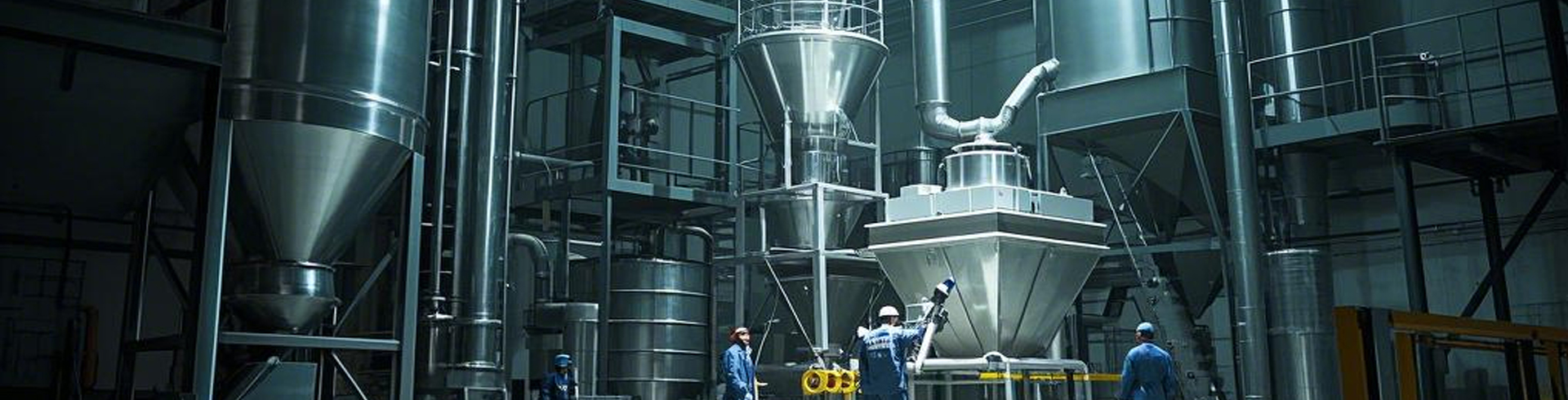
Lithium Battery Material Dumping: Dust-Free Handling for Cathode/Anode Powders
The global lithium battery industry is expanding rapidly, with cathode (LFP, NCM) and anode (graphite, silicon-carbon) powder production reaching millions of tons annually. However, the bag dumping stage faces three persistent challenges: ultra-fine dust escape, moisture ingress causing slurry gelation, and metallic contamination leading to self-discharge or short circuits.
This article provides a systematic guide to closed bag dumping solutions for lithium battery cathode and anode powders — covering moisture control, explosion protection, and magnetic particle management.
1. Special Properties of Cathode/Anode Powders: Ultra-Fine, Hygroscopic, Sensitive to Moisture & Metals
Ultra-Fine Particle Size (D50 0.5-20μm)
Jet-milled cathode (LFP/NCM) and anode (graphite) powders are extremely fine and easily airborne.
Hygroscopic (Moisture <500ppm Target)
Cathode materials absorb moisture from air, causing slurry gelation and reduced battery performance.
Metal Contamination Sensitive
Trace Fe, Ni, Cr particles can cause micro-shorts or thermal runaway.
Combustible / Explosive
Aluminum, silicon, and fine graphite dust present explosion risks.
2. Material Comparison & Dumping Challenges
| Property | Cathode (LFP/NCM) | Anode (Graphite/SiC) | Station Countermeasure |
|---|---|---|---|
| Bulk Density | 0.5-1.2 g/cm³ | 0.3-0.9 g/cm³ | Lower density → higher airflow |
| Moisture Control | ≤500ppm | ≤1000ppm | Dry air / N₂ purge + air seals |
| Magnetic Limit | ≤50ppb | ≤100ppb | SS316L + magnetic separator |
| Explosion Class | St1-St2 | St1 | Anti-static + deflagration venting |
3. Key Technical Requirements for Battery Bag Dumping Stations
✅ Extremely Low Dust Emission
HEPA H13 filtration + enclosure achieves near-zero operator exposure (<1mg/m³).
✅ Cross-Contamination Prevention
Dedicated stations for cathode and anode lines. Mirror-polished surfaces, quick-disconnect for cleaning.
✅ Moisture Exclusion
N₂ or dry air purge in hopper and filter chamber prevents humidity ingress.
4. Explosion Protection & Anti-Static Design
| Design Element | Requirement | Battery Industry Consideration | |
|---|---|---|---|
| Anti-Static Filter | Surface resistance ≤10⁶Ω | Graphite is highly conductive → prevent leakage to ground | |
| Equipment Grounding | Resistance <10Ω | Dedicated grounding grid | |
| Deflagration Venting | Vent panels / Flameless venting | Prevent flame propagation into facility | |
| Isolation Valve | Install at duct inlet | Isolate collector from dumping area |
5. Magnetic Particle Control: Source Reduction
Integrate high-intensity magnetic separators (magnetic grid/cartridge) at the bag dump outlet or downstream conveying line:
- All SS316L housing + rare earth neodymium magnets (≥12,000 Gauss surface);
- Easy-pull magnetic rods for periodic cleaning;
- Differential pressure monitoring to prevent clogging.
6. Bag Dumping Station Integration for Battery Production
Manual bag dump station → Buffer hopper → Vacuum/screw conveyor → Magnetic separator → Weighing system → Slurry tank
7. Frequently Asked Questions
Q1: Can the same bag dumping station be used for both LFP and NCM cathode materials?
A: Strongly not recommended. Cross-contamination affects battery formulation consistency. Dedicated stations for different cathode types are preferred.
Q2: How does the station prevent moisture absorption for cathode materials?
A: The hopper and filter chamber are purged with N₂ or dry air (positive pressure). The entire system is kept as closed as possible to reduce exposure.
Q3: What special considerations are needed for graphite anode dumping?
A: Graphite is highly conductive and explosive. Use anti-static filters, grounding, and smooth crack-free surfaces to prevent dust accumulation.
Q4: Is a magnetic separator mandatory in the bag dumping station?
A: Yes for lithium battery materials. Installing magnetic separators at the hopper outlet or downstream significantly reduces metallic contamination and short-circuit risk.
Q5: Can existing standard bag dumping stations be retrofitted for lithium battery powders?
A: Possibly, but upgrades (material, explosion protection, N₂ purge) are costly. New purpose-designed stations are recommended.
Need a lithium battery cathode/anode dedicated bag dumping station?
Guanjiang provides explosion-proof, dry-air purged bag dumping stations with integrated magnetic separation for battery material handling.
Request Battery Solution →