Products Description
Need to convey abrasive or friable materials over long distances without excessive wear or degradation?
Guanjiang's Dense Phase Pneumatic Conveying System (Pressure Vessel Sending Tank) uses high pressure and low velocity to push discrete "plugs" of material through the pipeline. Unlike dilute-phase systems, this batch-type feeding system significantly reduces pipe wear, prevents particle degradation, and achieves a high solid-to-gas ratio for energy efficiency. A characteristic "whoosh" sound signals the completion of each conveying cycle. Powered by compressed air or nitrogen, it's the ideal solution for abrasive, granular, or friable materials over long distances.
Key Advantages
Exponentially reduces abrasion compared to dilute-phase systems. Extends pipeline life significantly — ideal for abrasive materials like cement, sand, and minerals.
Moves more material with less compressed air — higher energy efficiency than traditional systems. Reduces operating costs.
Engineered for complex, long-distance industrial pipelines — maintains stable batch-feeding cycles over hundreds of meters.
Low-velocity "plug" flow prevents fragile granules from breaking — ideal for friable materials, grains, and pellets.
System Components
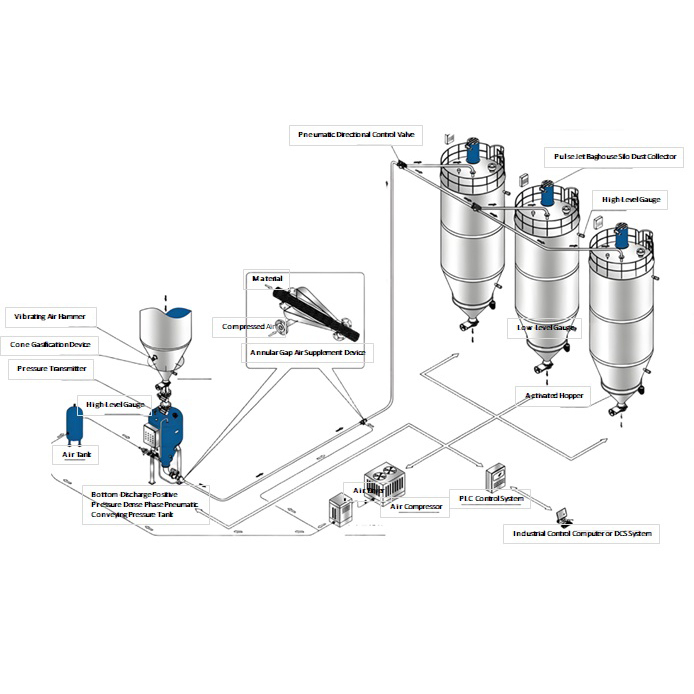
The pressure vessel dense phase conveying system consists of:
Core Pressure Vessel Unit:
- Pressure Vessel (Sending Tank / Autoclave)
- Bottom-discharge positive pressure tank
- Activated hopper with cone gasification device
- Vibrating air hammer (for bridging prevention)
Valve Group & Instrumentation:
- Feed valve / Discharge valve
- Air inlet valve / Balance valve
- Safety valve
- Pressure transmitter
- High-level / Low-level gauge
Downstream & Control:
- Conveying pipeline
- Terminal separation silo with dust collector
- Rotary valve
- PLC control system (Industrial PC or DCS)
- Air tank / Compressor
Power Source: Compressed air or compressed nitrogen.
Technical Specifications
| Parameter | Specification |
|---|---|
| Conveying Mode | Batch feeding (dense phase plug flow) |
| Power Source | Compressed air / Compressed nitrogen |
| Operating Pressure | 0.2 ~ 0.8 MPa (depending on distance and material) |
| Conveying Distance | Up to 1000+ meters (custom engineered) |
| Solid-to-Gas Ratio (μ) | 20 ~ 100 (dense phase) |
| Conveying Velocity | 3 ~ 8 m/s (low velocity for wear reduction) |
| Pressure Vessel Material | Carbon steel / Stainless steel (for food/pharma) |
| Control System | PLC with HMI / Integration with DCS |
Suitable Materials:
This system is typically suitable for long-distance conveying pipelines and granular materials with good fluidity — both abrasive and non-abrasive types. Common examples: Cement, fly ash, sand, minerals, grains, plastic pellets, and friable materials that would degrade in high-velocity systems.
Dense Phase System FAQs
Q1: Why is a sending tank system better for abrasive materials?
A: Because it moves material at much lower velocities (3-8 m/s) than dilute-phase systems (15-30 m/s). Since abrasion rate increases exponentially with velocity (proportional to V² or V³), dense phase significantly extends pipeline life — typically 3-5 times longer than dilute-phase for the same abrasive material.
Q2: What is the "whoosh" sound at the end of the cycle?
A: It is a characteristic feature of pressure vessel dense phase systems. The sound indicates the completion of the batch conveying cycle — the high-pressure gas has fully cleared the pipeline of material, readying the system for the next load. Operators use this auditory cue for cycle monitoring.
Q3: How does the batch feeding cycle work?
A: The pressure vessel is filled from a hopper via the feed valve. The air inlet valve is closed, and the balance valve equalizes pressure. Once filled, the feed valve closes, and high-pressure air enters the vessel. The discharge valve opens, and material is pushed as a "plug" through the pipeline. When the pressure drops (the "whoosh" sound), the cycle repeats.
Q4: What options are available for preventing bridging in the pressure vessel?
A: We offer vibrating air hammers, cone gasification devices (fluidization pads), and mechanical agitators. These promote material flow into the discharge port and are especially important for cohesive or poorly flowing powders.
Q5: Can the system be used with nitrogen instead of compressed air?
A: Yes. For explosive or oxygen-sensitive materials (e.g., organic powders, lithium battery materials), we offer compressed nitrogen as the power source. The system is fully sealed and designed for inert gas recirculation if required.
Need a low-wear, long-distance dense phase conveying solution for abrasive materials?
Request a Quote → Download Datasheet (PDF)* Please provide your material type (abrasive/friable), required conveying distance, capacity (T/h), and any ATEX or nitrogen requirements for a fast, accurate quotation.