Products Description
Need to transfer large volumes of powder or granules over extreme distances with high efficiency and low maintenance?
Guanjiang's Positive Pressure Dilute-Phase Pneumatic Conveying System is the definitive solution for long-distance, high-capacity material handling. Using a Roots blower or high-pressure centrifugal fan, it conveys materials at high velocity through pipelines. Achieve up to 100 T/h throughput over 1500 meters, with multi-point discharge capability to multiple silos or processing lines. The system features low operational costs, full automation, and minimal wear, making it ideal for chemicals, plastics, food, and building materials.
Key Performance Features
Capable of conveying materials up to 1500 meters horizontally and custom vertical heights. Overcomes complex plant layouts with flexible pipeline routing.
Optimized for large-scale operations with maximum capacity of 100 Tons per hour. Supports continuous or intermittent operation to suit any production schedule.
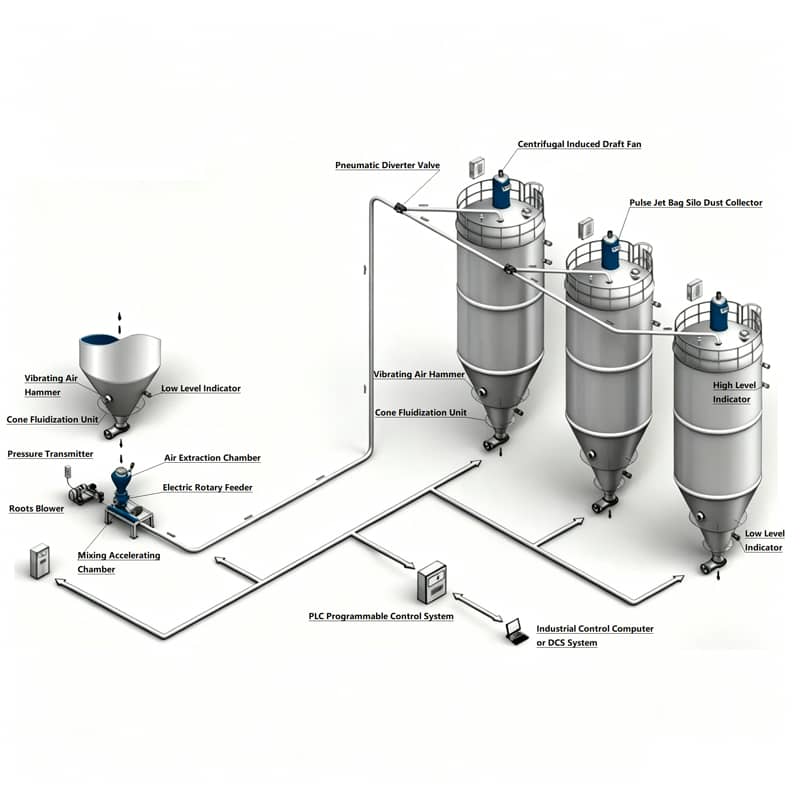
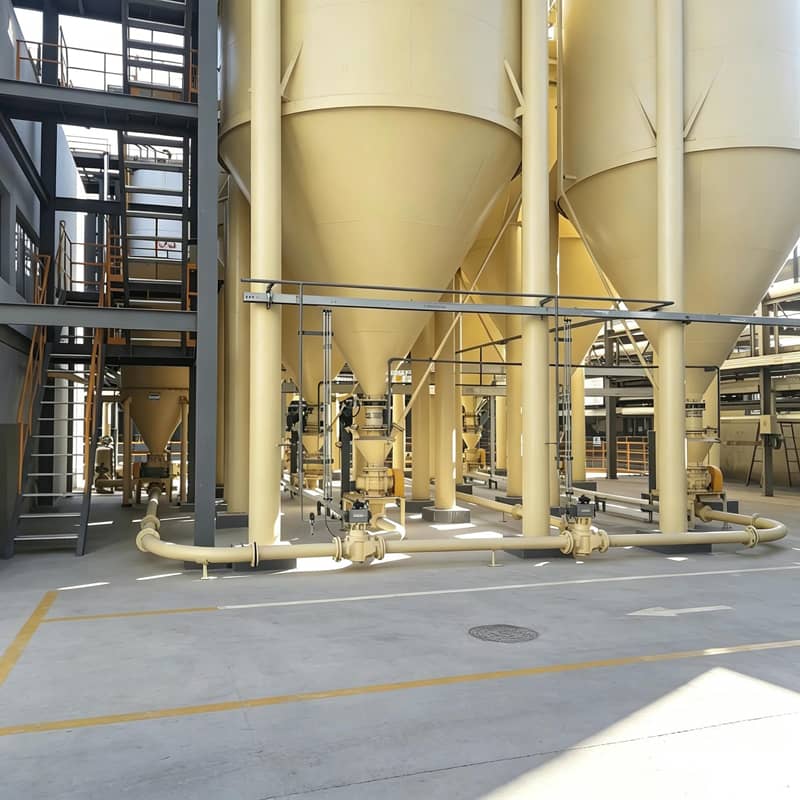
Easily configured to deliver materials from one source to multiple silos or lines using diverter valves. Supports complex, multi-source, multi-destination layouts.
Operating pressure < 0.1 MPa and low conveying velocity ensure safe, reliable flow. High solid-gas ratio drastically reduces energy consumption and operational costs.
How It Works: System Overview
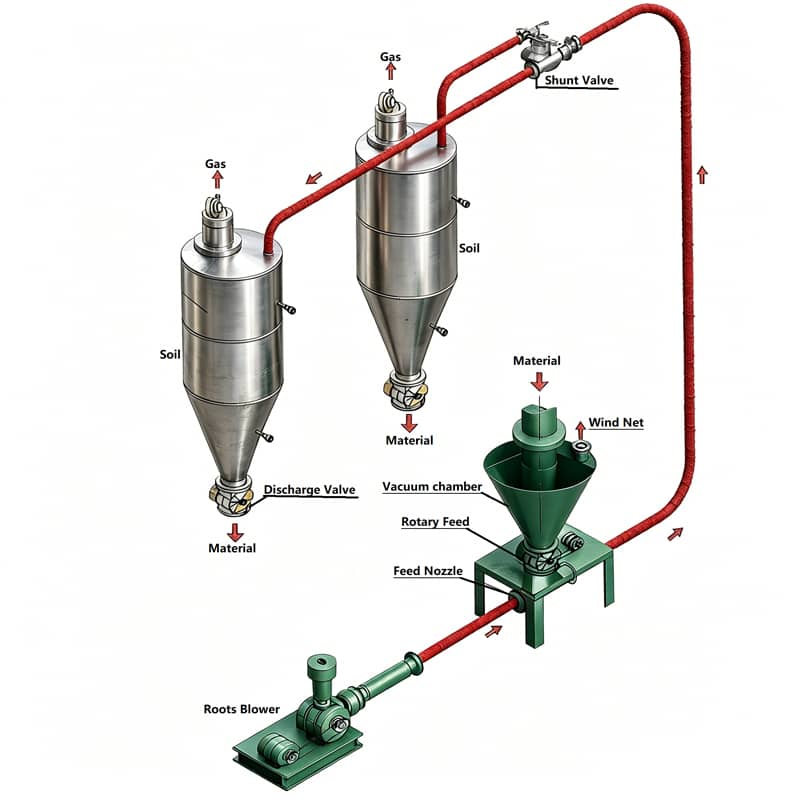
The positive pressure system uses air or nitrogen (< 0.1 MPa) to push material through pipelines at high speed. The process begins with a Roots blower generating high-pressure airflow. Material is fed via a rotary feeder into the air stream, creating a solid-gas mixture. This mixture is then propelled through the pipeline to a cyclone or baghouse separator, where the material is discharged and clean air is vented.
Operational Phases: The system operates in a cyclic sequence: Loading (material fills the pressure vessel), Fluidization (air is injected to fluidize the material), Conveying (material is pushed through the pipeline), and Purging (compressed air cleans the line). This fully automated cycle ensures continuous, efficient transport.
Core System Components
Power Source
Roots blower / High-pressure centrifugal fan provides the energy for conveying.
Feeder
Rotary feeder / Venturi injector mixes material with air and feeds it into the line.
Pipeline & Valves
Carbon/Stainless steel pipes with diverter valves for multi-point routing.
Separation & Filtration
Cyclone separator + baghouse filter to collect material and clean exhaust air.
Technical Specifications
| Parameter | Specification / Range |
|---|---|
| Conveying Capacity | Up to 100 T/h (customizable) |
| Max. Conveying Distance | Up to 1500 meters horizontal (vertical customizable) |
| Operating Pressure | < 0.1 MPa (positive pressure) |
| Solid-Gas Ratio (μ) | 30 ~ 60 kg/kg (highly efficient) |
| Conveying Velocity | Initial: 3-6 m/s, Final: 12-18 m/s, Average: 8-12 m/s |
| Operating Temperature | -20°C to 450°C (material dependent) |
| Power Source | Roots blower / High-pressure centrifugal fan |
| Pipeline Diameter | DN50 ~ DN300 (customizable) |
System Advantages & Applications
Key Advantages
- High Pressure, High Capacity: Handles large volumes over extreme distances with boosters.
- Low Velocity, Low Wear: Reduces abrasion on pipelines and material degradation.
- Energy Efficient: High solid-gas ratio significantly lowers operational costs.
- Flexible Layout: Supports single-to-multiple and multiple-to-multiple point configurations.
- Fully Enclosed & Clean: Zero dust leakage, meeting strict environmental regulations.
- Low Maintenance: Robust design with minimal wear points and easy module replacement.
Typical Applications & Materials
- Plastics & Rubber: PVC, PE, PP pellets, carbon black, rubber particles.
- Food & Beverage: Flour, sugar, starch, milk powder, grains, coffee beans.
- Chemicals & Minerals: Pigments, resins, fertilizers, cement, fly ash.
- Battery Materials: Lithium battery cathode/anode powders (NCM, LFP, graphite).
- Specialty Materials: Super-absorbent resin, elastomers, and friable materials.
Pneumatic Conveying FAQs
Q1: When should I choose positive pressure over vacuum conveying?
A: Positive pressure systems are superior for long distances (>50m) and high capacities (>10 T/h), or when you need to distribute material from one source to many destinations. Vacuum systems are better for short distances, multiple pickup points, or when drawing material from open containers.
Q2: What are the typical power requirements for a Roots blower system?
A: Power depends on required capacity and distance. Typical range: 7.5 kW to 250 kW. For example, 15 T/h over 200m requires approximately 37-45 kW. We provide a full power calculation based on your specific parameters.
Q3: Can the system handle abrasive or fragile materials?
A: Yes. The system's low conveying velocity (average 8-12 m/s) minimizes pipe wear and prevents degradation of fragile materials. For highly abrasive materials, we recommend hardened pipe elbows and wear-resistant liners.
Q4: How do you prevent pipeline blockages?
A: Blockage prevention measures include: proper air velocity design (minimum saltation velocity), automatic blowback system, pressure sensors with alarms, and variable frequency drive for velocity adjustment. For sticky materials, we recommend air cannons or purge connections at critical points.
Q5: Can the system be used for multiple discharge points and complex layouts?
A: Yes. Positive pressure systems excel at multi-point discharge. We integrate diverter valves (2-way, 3-way, or 4-way) or rotary distributors to route material to different silos, hoppers, or processing lines. The system supports single-to-multiple and multiple-to-multiple configurations for maximum layout flexibility.
Need a high-capacity, long-distance pneumatic conveying solution?
Request a Quote → Download Datasheet (PDF)* Please provide your required throughput (T/h), conveying distance, material type, and number of discharge points for a fast, accurate quotation.