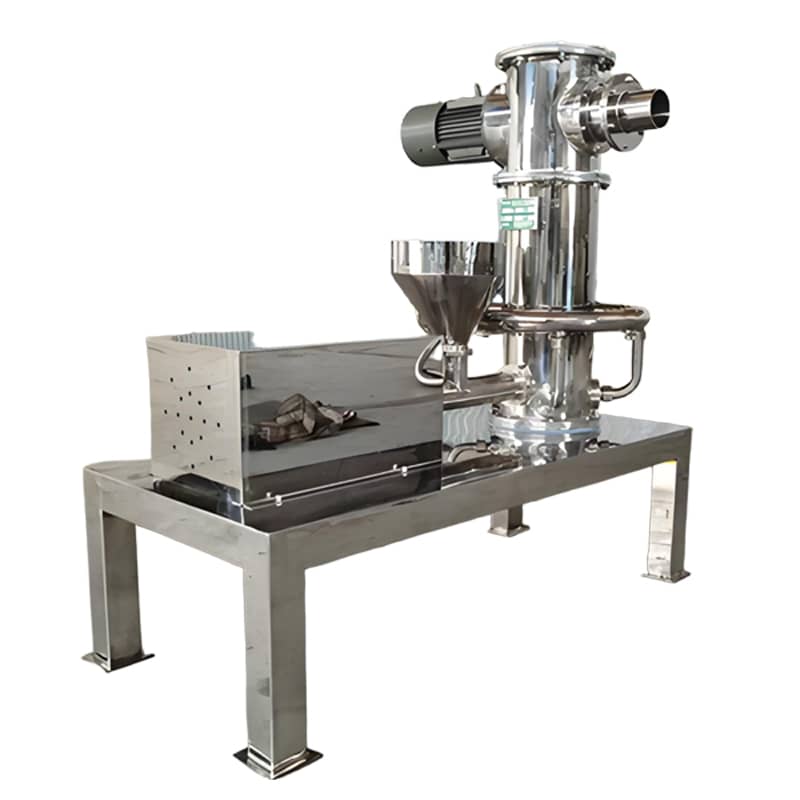
Products Description
Need to grind heat-sensitive materials to micron sizes without thermal degradation?
Guanjiang's Air Jet Mill uses high-velocity compressed gas to create particle-on-particle impact — achieving 0.5-30μm fineness while maintaining room temperature operation. No grinding media means zero contamination, and the self-impact mechanism reduces equipment wear. With 15-25% energy savings compared to traditional mills and advanced automatic controls, it's the ideal solution for pharmaceuticals, chemicals, food powders, and heat-sensitive APIs.
Key Features
Materials are ground under gas expansion, maintaining room temperature in the grinding chamber. Ideal for heat-sensitive materials like APIs, vitamins, and spices.
No additional grinding media introduced during process. Particle-on-particle impact eliminates media wear contamination — critical for high-purity pharmaceuticals and food.
Main grinding mechanism relies on mutual particle impact, not mechanical impact against chamber walls. Significantly reduces inner wall wear and maintenance costs.
Higher energy efficiency compared to traditional grinding equipment. Saves 15-25% energy while achieving finer particle sizes (0.5-30μm).
Modern jet mills are equipped with advanced automatic control systems — simple operation and real-time display of operating status. PLC integration available.
Technical Specifications (GJQF Series)
| Model | GJQF-10 | GJQF-100 | GJQF-200 | GJQF-380 | GJQF-500 | GJQF-1000 |
|---|---|---|---|---|---|---|
| Capacity (kg/h) | 0.5-10 | 5-100 | 50-200 | 80-380 | 200-500 | 400-1000 |
| Gas Consumption (m³/min) | 2 | 3 | 6 | 10 | 20 | 40 |
| Pressure (MPa) | 0.70 - 0.90 | |||||
| Particle Size (mesh) | 60 - 325 | |||||
| Grinding Fineness (μm) | 0.5-30 | 0.5-30 | 0.5-30 | 0-30 | 0.5-30 | 0.5-30 |
| Motor Power (kW) | 20 | 40 | 60 | 95 | 118 | 376 |
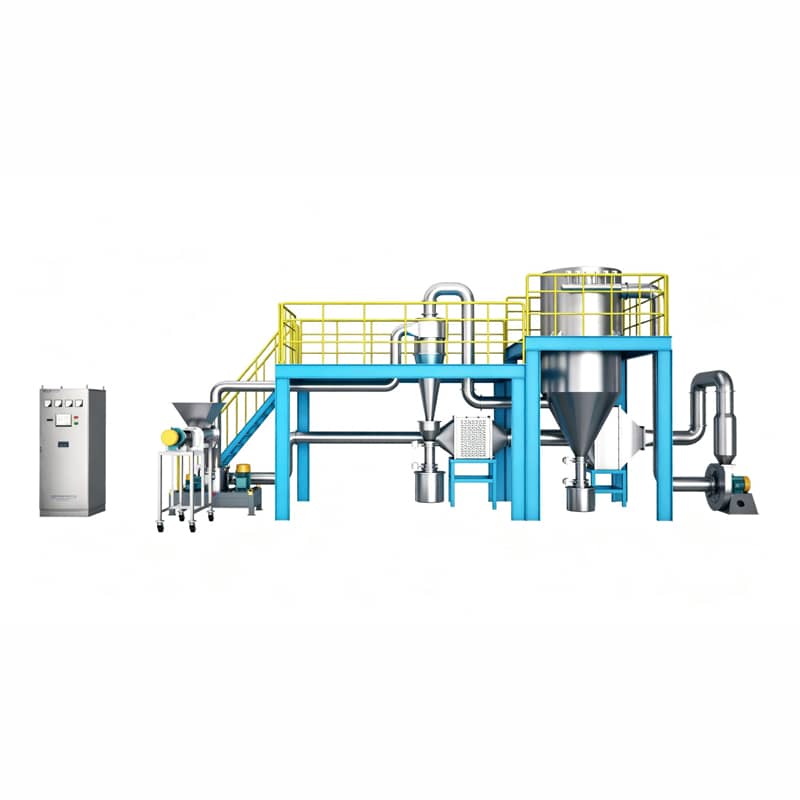
System Components
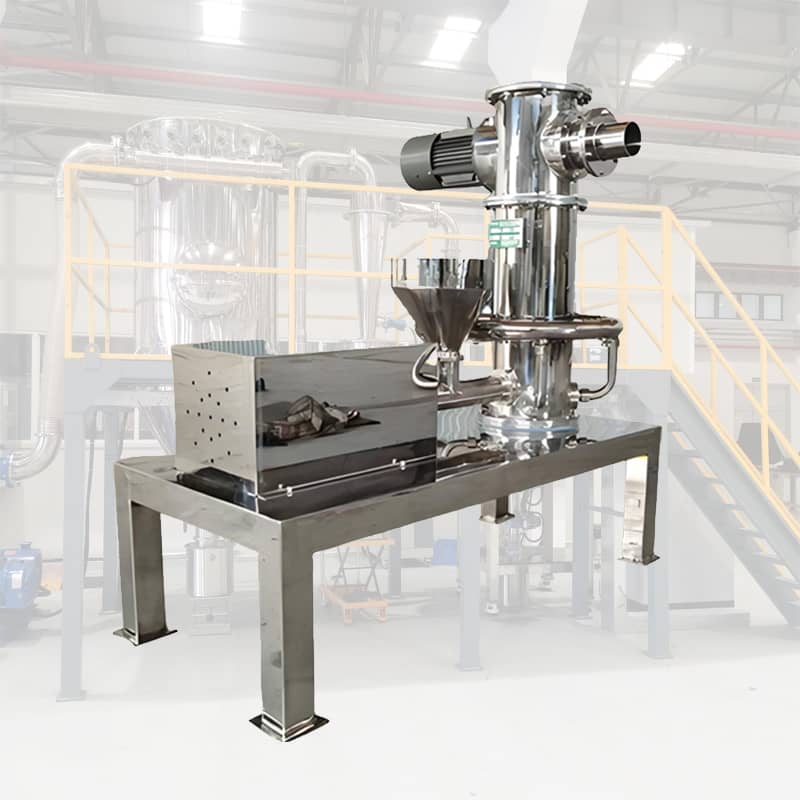
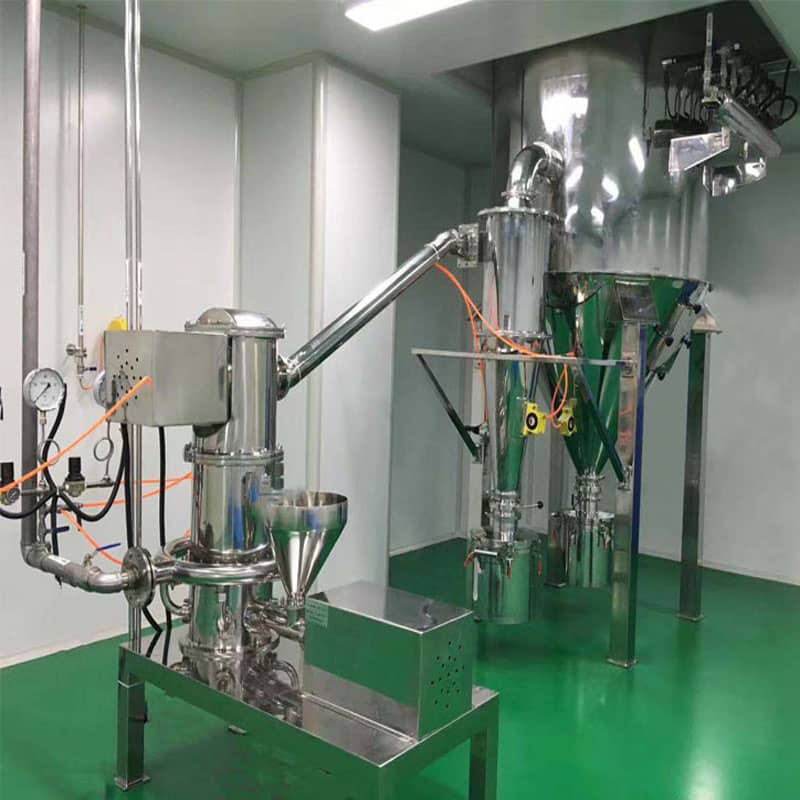
Key Components:
- 1. Materials feeder
- 2. Classifier motor
- 3. Classifier wheel
- 4. Outlet / Container
Process Components:
- 5. Collection container
- 6. Air distributor
- 7. Jet nozzle
- 8. Support structure
Control Options:
- PLC control with HMI
- Real-time status display
- Classifier speed control
- Air pressure regulation
Air Jet Mill FAQs
Q1: How does the jet mill achieve low-temperature grinding?
A: The grinding process uses gas expansion — as compressed gas expands through the jet nozzles, it absorbs heat (Joule-Thomson effect). This counteracts the frictional heat generated, keeping the grinding chamber at room temperature or below. No external cooling required for most heat-sensitive materials.
Q2: What is the difference between jet milling and mechanical milling?
A: Jet milling uses particle-on-particle impact with no moving parts in the grinding zone — produces finer particles (0.5-30μm), no media contamination, and low heat. Mechanical milling (hammer mills, pin mills) uses high-speed rotors and screens — generates more heat, higher wear, and potential metal contamination. Jet milling is superior for heat-sensitive and high-purity applications.
Q3: What gases can be used for jet milling?
A: Compressed air is most common for general applications. For oxygen-sensitive materials, we use compressed nitrogen. For explosive materials, inert gases like argon or CO₂ can be specified. The system is designed for gas recirculation to minimize operating costs.
Q4: How is particle size controlled?
A: The integrated classifier wheel separates fine particles from coarse ones. By adjusting the classifier speed, you can achieve different cut points (typically 0.5-30μm). Coarse particles are returned to the grinding chamber for further size reduction — ensuring narrow particle size distribution.
Q5: What materials can be processed with this jet mill?
A: Typical applications include: Pharmaceutical APIs (micronization for bioavailability), chemicals (pigments, dyes, agrochemicals), food (spices, fine powders), minerals (talc, mica), and battery materials (cathode/anode powders). Hardness up to Mohs 5 is recommended. Contact us for material testing.
Need a low-temperature, contamination-free jet mill for your fine grinding application?
Request a Quote → Download Datasheet (PDF)* Please provide your target fineness (μm), capacity (kg/h), material type, and any gas preference (air/nitrogen) for a fast, accurate quotation.