Products Description
Struggling with bridging, rat-holing, or inconsistent flow in your hoppers and silos?
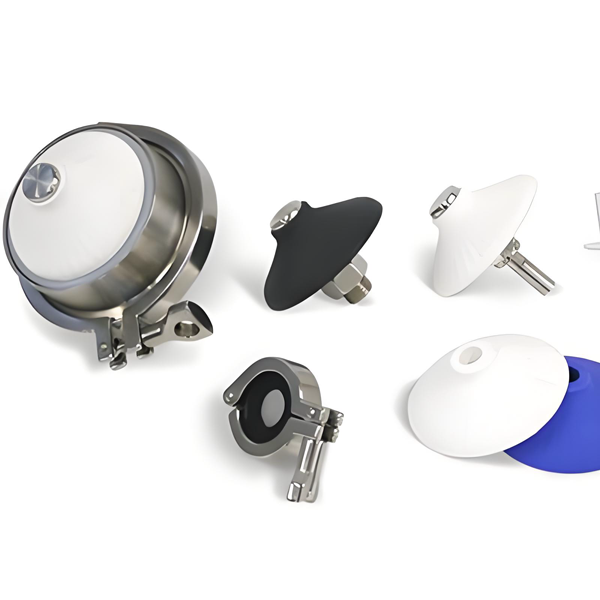
Guanjiang's Pneumatic Fluidizers (Bin Aerators) use controlled low-pressure air injection to transform compacted powders and bulk materials into fluid-like states for improved handling and flow. Employing precisely engineered porous membranes or air injection elements, they introduce air into material containers — effectively reducing internal friction and promoting smooth material discharge. Operating on compressed air (typically 0.5-3 bar), they prevent bridging, rat-holing, and other flow obstructions without moving parts in contact with material.
Key Advantages
Eliminates Bridging & Rat-Holing
Eliminates bridging and rat-holing in cohesive materials. Ensures consistent first-in-first-out material flow. Maintains uniform discharge rates without pulsation.
Low Air Consumption
Low air consumption (0.5-3 bar) minimizes operational costs. Optimized pressure requirements reduce energy usage. Continuous operation with minimal power draw.
Gentle Fluidization
Gentle fluidization prevents particle degradation. Maintains material characteristics and quality. Reduces segregation in blended products.
No Moving Parts
No moving parts in contact with material — minimal maintenance. Long service life with proper air filtration (5μm recommended).
Porous Membrane Technology
Sintered polyethylene or stainless steel membrane — even air distribution, prevents material backflow.
Food & Pharma Grades
316L stainless steel versions available — FDA compliant for food and pharmaceutical applications.
Multiple Sizes
Available for hoppers from 0.5m³ to 500m³ — multiple units can be ganged for larger silos.
How It Works
The fluidizer operates on the air-fluidization principle. Regulated compressed air permeates through a sintered porous membrane into the material mass:
? Air Injection
Low-pressure air (0.5-3 bar) enters through porous membrane.
⚪ Fluidization
Air creates quasi-liquid state, eliminating internal friction.
? Gravity Discharge
Fluidized material flows smoothly without bridging.
Technical Specifications
| Parameter | Specification | |
|---|---|---|
| Membrane Material | Sintered polyethylene / Sintered stainless steel (316L) | |
| Compressed Air Pressure | 0.5 ~ 3 bar (7 ~ 45 PSI) | |
| Air Consumption (per unit) | 0.1 ~ 0.5 m³/min (3.5 ~ 18 CFM) | |
| Body Material | Aluminum alloy / SS304 / SS316L | |
| Connection Thread | G1/8" / G1/4" / G3/8" / G1/2" | |
| Operating Temperature | -20°C ~ 80°C (PE membrane) / Up to 200°C (SS membrane) | |
| Membrane Pore Size | 5 ~ 40 microns (customizable) | |
| Installation | Welded flange / Threaded / Clamp (sanitary) | |
| Compliance | FDA (stainless steel version) / ATEX (optional) |
Selection & Installation Guide:
Number of units: For hoppers<2m³ 1-2="" units.="" 3-6="">10m³ — 6-10+ units. Install fluidizers in the discharge cone, starting 100-300mm above the outlet.
Air quality: Use clean, dry, filtered compressed air (5μm filtration, dew point < -20°C). Oil contamination will clog porous membranes.
Operation: Pulse intermittently (1-5 seconds on, 10-60 seconds off) for most materials. Continuous air flow for very cohesive materials.
Sanitary applications: Specify SS316L with electropolished finish and Tri-Clamp connection.
Applications
| Industry | Typical Applications |
|---|---|
| Cement & Construction | Silo discharge, cement feeding systems, fly ash handling |
| Food Processing | Flour handling, sugar processing, ingredient systems, starch flow |
| Pharmaceuticals | API handling, excipient flow improvement, powder transfer (stainless steel version) |
| Chemicals | Powder processing, additive feeding, pigment handling, resin discharge |
| Plastics | Resin handling, compound processing, pellet flow, regrind silos |
Frequently Asked Questions
Q1: How does a pneumatic fluidizer differ from a mechanical vibrator?
A: Pneumatic fluidizers use compressed air injection to fluidize material internally — no vibration, no noise, no impact on the container structure. Mechanical vibrators shake the container wall — can cause structural fatigue, noise, and potential damage. Fluidizers are preferred for fragile powders, sanitary applications, and large silos where vibration is undesirable.
Q2: Can fluidizer be used with fine, cohesive powders like flour or titanium dioxide?
A: Yes. Pneumatic fluidizers are highly effective for fine, cohesive powders. The air injection breaks internal bonds and eliminates bridging. For extremely cohesive materials, we recommend pulsed operation (1-3 seconds on, 30-60 seconds off) rather than continuous air flow. Smaller pore size membranes (5-10 microns) are available for very fine powders.
Q3: Is the fluidizer suitable for food/pharmaceutical applications?
A: Yes. We offer 316L stainless steel fluidizers with electropolished surfaces and FDA-compliant porous membranes. The design is crevice-free and easy to clean. Tri-Clamp connections are available for sanitary installation. Full material traceability documentation is provided.
Q4: How do I maintain the fluidizer?
A: Maintenance is minimal. Inspect membranes annually for wear or clogging. Clean with backflow of clean air or gentle brushing (do not use sharp objects). Replace membrane if damaged. Use clean, dry, filtered compressed air (5μm filtration, dew point < -20°C) to extend membrane life. For stainless steel membranes, ultrasonic cleaning is effective.
Q5: How many fluidizers do I need for my silo?
A: The number depends on silo diameter, cone angle, and material flowability. General guideline: 0.5-2m³ hopper → 1-2 units at 120° spacing. 2-10m³ silo → 3-6 units in the cone. 10-50m³ silo → 6-10 units. 50+m³ silo → custom layout based on CAD analysis. Contact us with your silo geometry and material for a specific recommendation.
Need a pneumatic fluidizer to solve bridging and flow problems in your hopper or silo?
Request a Quote → Download Datasheet (PDF)* Please provide your silo/hopper dimensions, material type, and any sanitary requirements for a fast, accurate quotation.