Products Description
Need continuous, high-precision dosing of powders or granules with zero dust exposure?
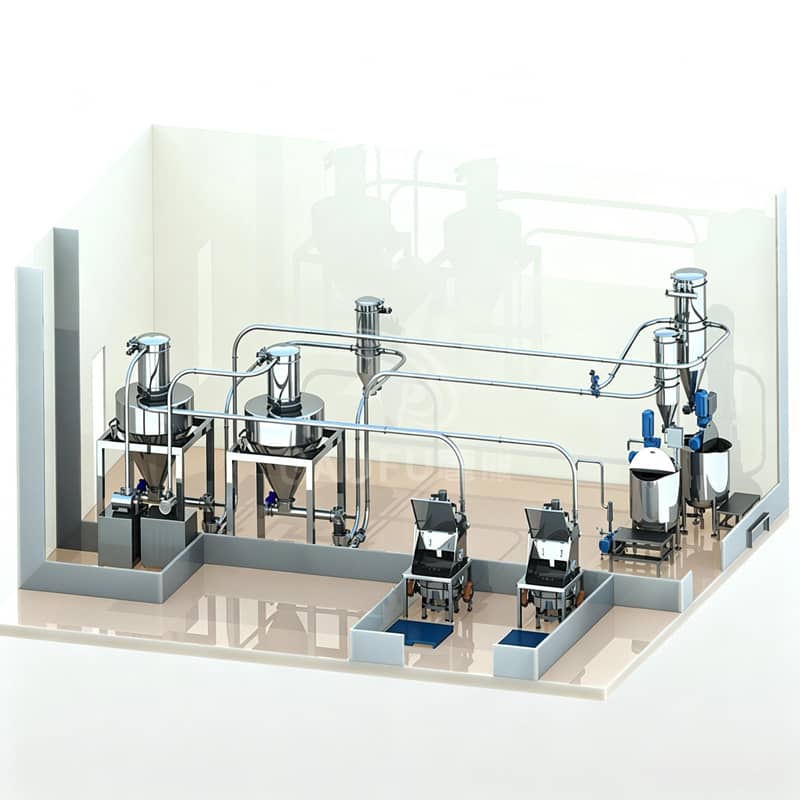
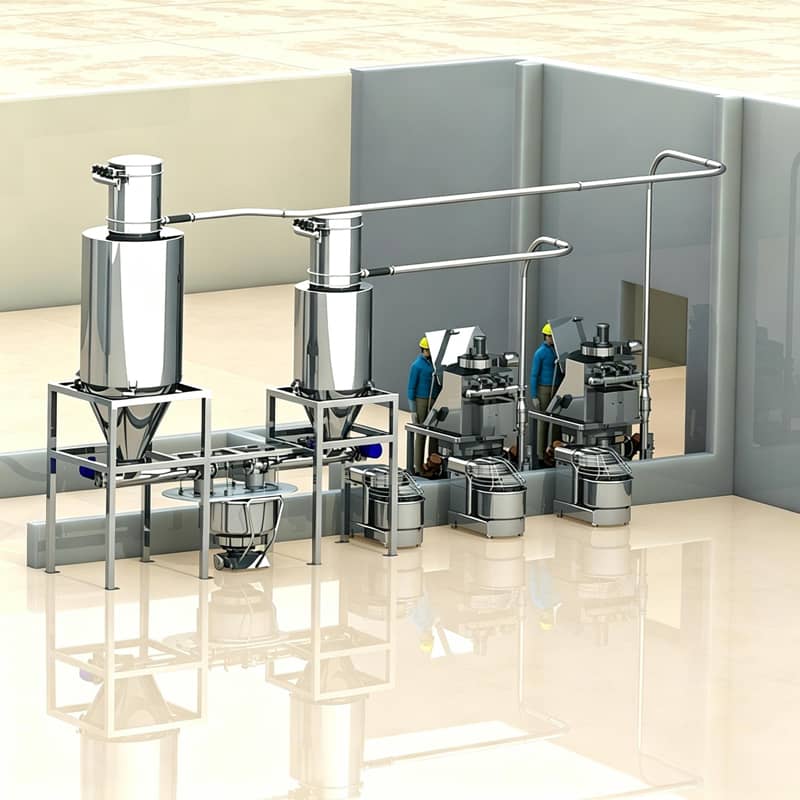
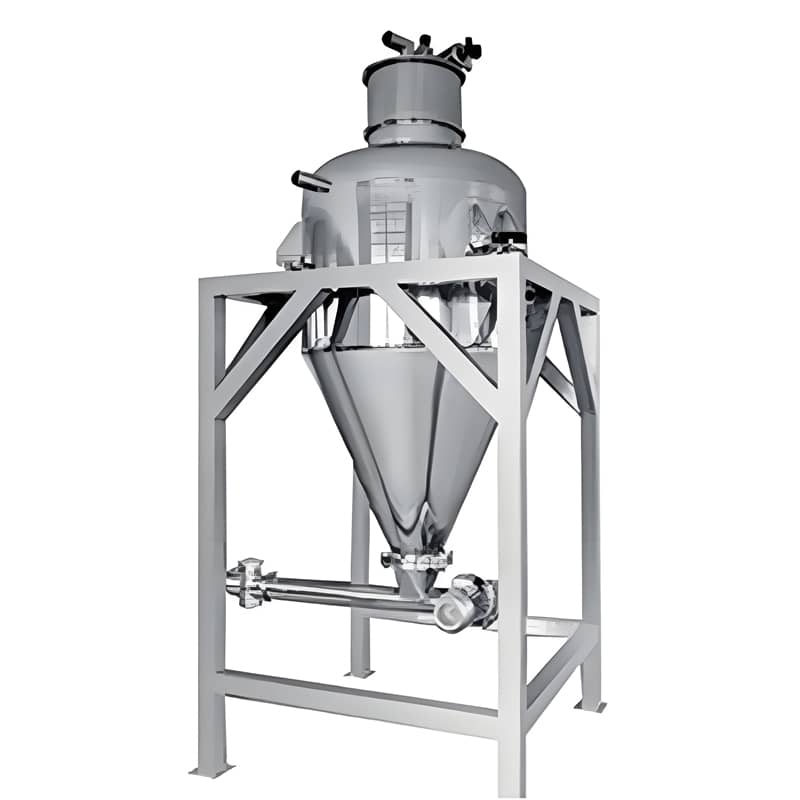
Guanjiang's Vacuum Feeding and Weighing System (Loss-in-Weight Feeder) combines dust-free vacuum conveying with real-time gravimetric dosing technology. The system continuously monitors weight loss to adjust feed rates, achieving ±0.2% dosing accuracy — even as material density changes. With total dust containment, PLC automation, and tool-free cleaning, it's the ideal solution for pharmaceutical APIs, high-value food additives, and precision chemical formulations.
Key Advantages
Real-time weight monitoring and loss-in-weight logic maintain accuracy within ±0.2% — compensates for material density changes, reduces waste, and ensures recipe consistency.
Sealed vacuum loop prevents any dust leakage — ideal for HPAPI (highly potent APIs), toxic powders, and food-grade safety environments. Protects operators and product purity.
Integrated PLC (Siemens/Mitsubishi) automates the entire "Convey-Weigh-Feed" loop with user-friendly HMI. Recipe storage, data logging, and remote access available.
Modular design with quick-release clamps allows rapid disassembly without tools. Thorough cleaning prevents cross-contamination between batches — fully GMP compliant.
Optimized for continuous production lines — maintains constant ingredient ratio throughout entire batch. Also supports batch weighing for recipes.
Optional pneumatic vibrators or mechanical agitators in the weighing hopper ensure consistent flow for sticky or poor-fluidity powders.
System logs actual feed rates, totalized throughput, and deviation alerts — supports batch traceability and quality reporting.
Technical Specifications
| Parameter | Specification Range |
|---|---|
| Dosing Accuracy | ±0.2% (typical, material dependent) |
| Feed Rate Range | 0.5 kg/h ~ 5,000 kg/h (customizable) |
| Hopper Volume | 10L, 20L, 40L, 80L, 150L, 300L (custom) |
| Material of Construction | SS304 / SS316L (GMP polished, Ra<0.4μm) |
| Weighing Sensor Type | High-precision strain gauge load cells (IP67/IP68) |
| Control System | PLC (Siemens / Mitsubishi) with 7" HMI touchscreen |
| Vacuum Source | Compressed-air venturi / Electric vacuum pump / Central system |
| Communication Protocol | Modbus TCP, Profibus, Ethernet/IP (optional) |
System Components & Options:
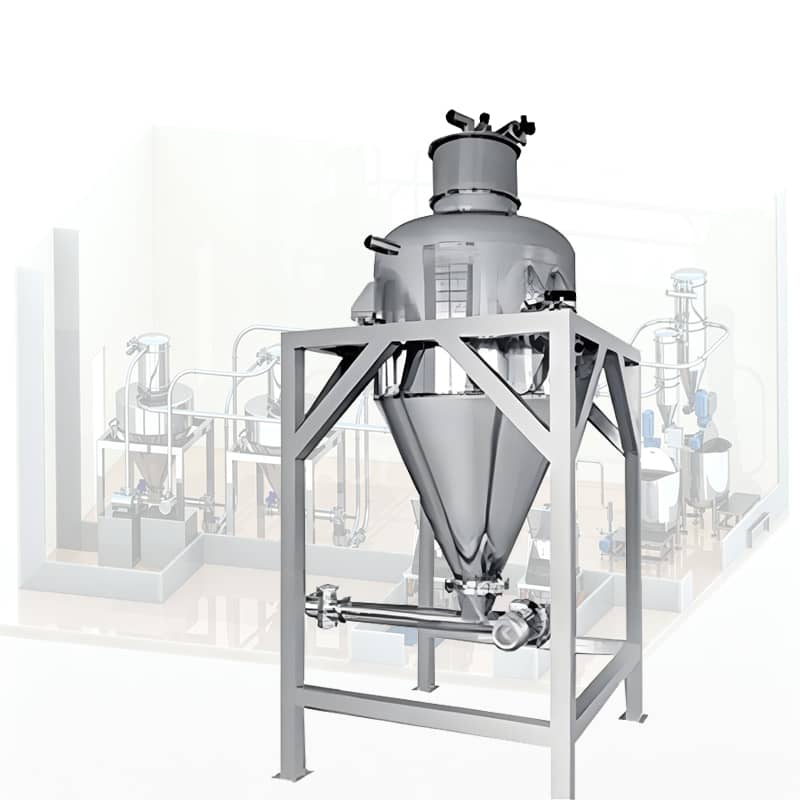
Standard package includes: Vacuum receiver with filter, weighing hopper with load cells, loss-in-weight controller, discharge valve (butterfly/slide gate), and PLC control panel.
Optional add-ons: Pneumatic vibrators / agitators for bridging prevention, CIP spray balls for automated cleaning, nitrogen purge for inerting, heated hopper for hygroscopic materials, and ATEX-rated components for explosive environments.
Dosing & Conveying Insights
Q1: Is this system suitable for continuous mixers?
A: Absolutely. Our loss-in-weight control logic is specifically optimized for continuous production lines. The system constantly adjusts feed rate based on real-time weight loss, ensuring the ratio of ingredients remains constant throughout the entire batch — ideal for extrusion, continuous blending, or compounding processes.
Q2: How does the system prevent bridge-building of sticky or poor-flowing powders?
A: We can integrate pneumatic vibrators or mechanical agitators within the weighing hopper. These devices gently shake or stir the material, breaking arches and ensuring consistent flow to the discharge screw or valve. For extremely cohesive materials, a ribbon-type agitator is available.
Q3: What is the difference between loss-in-weight and gain-in-weight feeding?
A: Loss-in-weight (LIW) measures the total weight loss of the hopper over time — ideal for continuous feeding and materials that change density. Gain-in-weight measures material added to a downstream vessel — better for batching. LIW is preferred for high-accuracy continuous processes because it compensates for density variations in real time.
Q4: How do you clean the system between different products?
A: The tool-free modular design allows operators to disassemble the vacuum receiver, weighing hopper, and discharge valve in minutes. All surfaces are mirror-polished stainless steel (Ra<0.4μm) with rounded corners. For automated cleaning, we offer an optional CIP (Clean-in-Place) system with spray balls that clean without disassembly — essential for pharmaceutical and food applications.
Q5: Can the system be used for highly potent APIs (HPAPIs) requiring containment?
A: Yes. The fully sealed vacuum loop and contained discharge connection make this system suitable for OEB 3-5 containment levels. We offer additional features: split butterfly valves, continuous liner bag systems, and glove box interfaces for safe material changeover. All seals are validated for containment efficiency.
Need a high-precision loss-in-weight feeding system for your continuous production line?
Request a Quote → Download Datasheet (PDF)* Please provide your required feed rate (kg/h), material type, accuracy requirement, and whether continuous or batch dosing is needed for a fast, accurate quotation.